Tuesday, September 18, 2018

LAB #09: Thevenin's Theorem


OVERVIEW:
The purpose of this lab was to sketch, analyze, and build a circuit with independent sources. Our primary technique for solving this circuit is Thevenin's Theorem.

PROCEDURE:
Pre-Lab:
As instructed in the ENGR 44 Lab book, use Thevenin's theorem to find the Thevenin equivalent of the circuit in Figure 1. Our goal is to find Vth and Rth.

Lab:
  1. Construct the circuit given in the lab book, and measure Voc and Rth.
  2. Calculate the percent difference between your predicted values and measured values for Vth and Rth respectively.
Original Circuit
Thevenin Equivalent Circuit


ANALYSIS:
Pre-Lab:
Ideal Resistance Values:
R1 = 1k
R2 = 2.2k
R3 = 1.5k (or 1.3k)
R4 = 4.7k
R5 = 6.8k (side)
R6 = 6.8k (bottom)
RL = 10k

Predicted Voltage and Resitance Values:
A) Voc = Vth =  0.4565 V
B) Rth = Req = 7.4k

Rth Calculation

Voc Calculation

Lab:
Measured Resistance Values:
R1 = 1.11k
R2 = 2.2k
R3 = 1.2k
R4 = 4.69k
R5 = 6.63k (side)
R6 = 6.79k (bottom)
RL = 5.62k

Actual Voltage and Resistance Values:
A) VL = 0.4395V ==> Vth = 0.4395V
B) Req = Rth = 7.39k

Voc on OG circuit

Voc on Thevenin Equivalent Circuit

Maximum Power Transfer to Load Resistor:
Pmax ==> Rth = RL
==> Pmax = V^2/(RL)
==> Pmax = 0.25*(Vth)^2/Rth
==> Pmax = _______

Part 2:
Percent error between predicted and measured voltage:
Error in Vth: (|0.4565 - 0.4395| / 0.4565)* 100 = 3.72%
Error in Rth: (|7.4 - 7.39| / 7.4)* 100 = 0.135%

CONCLUSION:
Our measured values for voltage difference Vth and the Thevenin Resistance Rth matched relatively close to their corresponding predicted values. During the pre-lab, we used Thevenin's to predict the values of Vth and Rth and we found these values to be 0.4565 V and 7.4k, respectively. For the actual lab, we measured Vth = 0.4595 V and Rth = 7.39k, which corresponds to a percent error of 3.72% and 0.135%  respectively. This uncertainty is likely due to the internal resistance of the DMM, which may have caused our measured voltage values to be slightly off. Another possible source of error is the fact that many of our resistance values did not match up perfectly with their ideal values. Another source of uncertainty to consider is that we did not directly measure Vth, but calculated it using the voltage divider rule--- utilizing measured values of VL, RL, and Rth.

MATLAB PROBLEM:
Our professor gave us this Thevenin problem to complete in Matlab.
Thevenin Equivalence problem
Since I don't currently own Matlab, I have worked the problem out by hand. Here are my results:

Vth = Voc = 10.67 V
Rth = Req = 8.889 ohms

Mesh Analysis to find Voc
Wye-Delta Transformation to find Req


Wednesday, June 13, 2018

Final Project: Bluetooth Speaker

For my final project, I created a simple audio amplifier using the NTE823 op-amp. My amplifier is powered by a nine-volt battery with a 10 microfarad capacitor in parallel. The capacitor is connected close to the Vcc pin to ensure that the amplifier receives the power it needs for loud bass notes. Additionally, I connected a green LED and a current-limiting resistor in series with the battery as a visual indicator that the circuit was live. The input for my audio amplifier is a male stereo headphone jack.

Since there is only one input pin for the op-amp, I had to convert the stereo signal to a mono signal by putting two 1k ohm resistors in series with the left and right signal wires. I also connected pins 1 and 8 together with a 10 microfarad capacitor in series with a 10k ohm potentiometer. By varying the resistance across pins 1 and 8, I am able to adjust the gain of the NTE823 from 20 to 200. However, in order to connect pins 1 and 8, we must short the bypass pin (7) with a 10 microfarad capacitor. I also connected a 0.1 microfarad capacitor in parallel with the output speaker for filtering out white noise. Similarly, I connected a 1000 microfarad decoupling capacitor in series with the output speaker to ensure that there is no DC offset present in the output audio signal. I also have a switch that allows me to alternate between aux mode and Bluetooth mode.

When the switch is moved, it sends the nine volts from the battery through an L4940V5 voltage regulator to power the USB Bluetooth dongle. I really like this Bluetooth dongle because it is simple to implement---i.e. just plugging the male audio jack into it. I also put a couple of 10 microfarad capacitors in parallel with the input and output of the 5V regulator to ensure that I was consistently receiving a five-volt output. Unfortunately, I learned the hard way that linear voltage regulators such as the one I used tend to have a lot of noise at the output and are therefore impractical for noise sensitive applications such as audio amplification. To remedy this issue, I inserted an emitter follower circuit using a BJT and a high pass filter to minimize the high-frequency signals I was getting from the voltage regulator. This circuit worked moderately well, but there is still some audible noise present in the output of the speaker. Another way I could have solved this issue is by using a high pass filter with an op-amp.

Note: This circuit could have also been done using the LM-386 op-amp. This is because they have the same pinout and function very similar to one another.


Monday, April 2, 2018

LAB #08: Dusk to Dawn Light

OVERVIEW:
The purpose of this lab was to sketch, analyze, and build a light-sensor circuit using a BJT, an LED, and a photoresistor.

PROCEDURE:
Pre-Lab:
As illustrated in the ENGR 44 Lab book, use KVL on the outer loop of the circuit in Figure 1 to determine to determine the predicted voltage difference Vb when the resistance across the photoresistor is:
  • R = 8.25k (uncovered)
  • R = 11.37k (covered)
Lab:
  1. Construct the circuit given in the lab book, measure the base voltage of the BJT, Vb and the voltage across the LED, Vd for both resistances in the pre-lab.
  2. Calculate the percent difference between your predicted values and measured values for Vb.
Physical Circuit
ANALYSIS:
Pre-Lab:
Predicted Voltage Values:
A) Vb = 2.26 V (uncovered, R = 8.25k)
B) Vb = 2.66 V (covered, R = 11.37k)

Pre-Lab Calculations w/ Circuit Schematic

Lab:
Actual Voltage Values:
A) Vb = 2.3 V (uncovered, R = 8.25k)
B) Vb = 2.53 V (covered, R = 11.37k)

C) Vd = 1.86 V (uncovered, R = 8.25k)
D) Vd = 1.78 V (covered, R = 11.37k)

Sample: Vd Measurement on DMM
Sample: Vb Measurement on DMM
Part 2:
Percent error between predicted and measured voltage:
Error in Vb (uncovered): (|2.26 - 2.3| / 2.26)* 100 = 1.76%
Error in Vb (covered): (|2.66 - 2.53| / 2.66)* 100 = 4.89%

CONCLUSION:
Our measured values for the voltage difference Vb matched relatively close to their corresponding predicted values. During the pre-lab, we used KVL to predict the values of Vb and we found these values to be 2.26 V when the photoresistor was uncovered and 2.66 V when the photoresistor was covered. For the actual lab, we measured Vb (uncovered) = 2.3 V and Vb (covered) = 2.66 V, which corresponds to a percent error of 1.76% and 4.89%  respectively. This uncertainty is likely due to the internal resistance of the DMM, which may have caused our measured voltage values to be slightly off. Another possible source of error is the release of thermal energy due to the resistors.

Sunday, April 1, 2018

LAB #07: Mesh Analysis III

OVERVIEW:
The purpose of this lab was to analyze, build, and test a circuit with multiple sources. Once again, we use mesh analysis as our primary solving technique.

PROCEDURE:
Pre-Lab:
As illustrated in the ENGR 44 Lab book, use mesh analysis techniques to analyze the circuit in Figure 1 to determine the mesh currents; and predict the voltage difference V1 and current I1 using these mesh currents. Note: this is the exact same circuit used in my Nodal Analysis III lab.

Lab:
  1. Construct the circuit given in the lab book, measure V1 and I1 using DMM.
  2. Calculate the percent difference between your predicted values and measured values.
Physical Circuit (Zoomed In)
Physical Circuit (Zoomed Out)

ANALYSIS:
Pre-Lab:
Ideal Resitance Values:
R1 = 1.5 k
R2 = 4.7 k
R3 = 6.8 k
R4 = 20 k

Predicted Voltage and Current Values:
A) V1 = 2.394 V
B) I1 = 0.263 V

Pre Lab Calculations w/ Circuit Schematic

Lab:
Part 1:
Actual Resistance Values:
R1 = 1.20 k
R2 = 4.63 k
R3 = 6.73 k
R4 = 21.8 k

Actual Voltage and Current Values:
V1 = 2.34 V
I1 =  0.28 V
V1 measured on DMM

Part 2:
Percent error between predicted and measured voltage:
Error in V1: (|2.394 - 2.34| / 2.394)* 100 = 2.26%
Error in I1: (|0.263 - 0.28| / 0.263)* 100 = 6.46%

CONCLUSION:
Our measured values for the voltage difference V1 and current I1 matched relatively close to their corresponding predicted values. During the pre-lab, we used mesh analysis to predict the values of V1 and I1 and we found these values to be 2.394 V and 0.263 mA respectively. For the actual lab, we measured Vl = 2.34 V and I1 = 0.28 mA, which corresponds to a percent error of 2.26% and 6.46%  for V1 and I1 respectively. This uncertainty is likely due to the internal resistance of the DMM, which may have caused our measured voltage, current, and resistance values to be slightly off. Another possible source of error is our actual resistance values, which did not match up perfectly with their ideal values.

Saturday, March 31, 2018

LAB #06: Mesh Analysis II

OVERVIEW:
The purpose of this lab was to analyze, build, and test a circuit with multiple sources. Once again, we will solve the circuit using mesh analysis.

PROCEDURE:
Pre-Lab:
As illustrated in the ENGR 44 Lab book, we will analyze the circuit in Figure 1 using mesh analysis techniques to determine the mesh currents; and predict the voltage differences V1 and V2 using those mesh currents. Please note that this is essentially the same circuit used in my Nodal Analysis II lab.

Lab:
  1. Construct the circuit; measure and record all actual resistance values. Measure V1, V2, and I1 in the circuit.
  2. Calculate the percentage error between your measured values and your predicted values for V1 and V2 respectively.
Actual Circuit Built

ANALYSIS:
Pre-Lab:
Predicted Voltage Values:
V1 = 4.999 V
V2 = 1.224 V

Predicted Current Values:
i1 = .0604 mA
i2 = I1 = -0.3208 mA
i3 = -1.056 mA

Pre-Lab Calculations w/ Circuit Diagram
Lab:
Part 1:
Actual Resistance Values:
R1 = 20 k
R2 = 4.7 k
R3 = 10 k
R4 = 6.8 k

Actual Voltage Values:
V1 = 4.98 V
V2 = 1.23 V

Actual Current Values:
I1 = -0.366 mA
i1 = 0.066 mA

i1 on DMM

Part 2:
Percent error between predicted and measured voltage:
Error in V1: (|4.999 - 4.98| / 4.999)* 100 = 0.380%
Error in V2: (|1.224 - 1.23| / 1.224)* 100 = 0.490%

CONCLUSION:
Our measured values for V1 and V2 are definitely within a reasonable margin of error. During the pre-lab, we used mesh analysis to predict the values of V1 and V2. We found these values to be 4.999 V and 1.224 V respectively. For the actual lab, we measured Vl = 4.98 V and V2 = 1.23 V. This corresponds to a percent error of 0.380% and 0.490%  for V1 and V2 respectively. This uncertainty is likely due to the internal resistance of the DMM.

LAB #05: Mesh Analysis

OVERVIEW:
The purpose of this lab was to analyze, build, and test a circuit with multiple sources. This time, we will solve the circuit using mesh analysis.

PROCEDURE:
Pre-Lab:
As illustrated in the ENGR 44 Lab book, we will analyze the circuit in Figure 1 using mesh analysis techniques to determine the voltage differences V1 and V2. Please note that this is essentially the same circuit used in my Nodal Analysis lab.

Lab:
  1. Construct the circuit; measure and record all actual resistance values. Measure V1 and V2 in the circuit.
  2. Calculate the percentage error between your measured values and your predicted values for V1 and V2 respectively.
Physical Circuit (Zoomed In)
Physical Circuit (Zoomed Out)

ANALYSIS:
Pre-Lab:
Predicted Voltage Values:
V1 = 2.356 V
V2 = 4.356 V

Pre-Lab Calculations on Whiteboard


Lab:
Part 1:
Actual Resistance Values:
R1 = 10 k
R2 = 20 k
R3 = 6.8k

Actual Voltage Values:
V1 = 2.34 V
V2 = 4.32 V

V1 on DMM
V2 on DMM
Part 2:
Percent error between predicted and measured voltage:
Error in V1: (|2.356 - 2.34| / 2.356)* 100 = 0.679%
Error in V2: (|4.356 - 4.32| / 4.356)* 100 = 0.826%

CONCLUSION:
Our measured values for V1 and V2 are definitely within a reasonable margin of error. During the pre-lab, we used mesh analysis to predict the values of V1 and V2. We found these values to be 2.356 V and 4.356 V respectively. For the actual lab, we measured Vl = 2.34 V and V2 = 4.32 V. This corresponds to a percent error of 0.679% and 0.826%  for V1 and V2 respectively. This uncertainty is likely due to the internal resistance of the DMM.

Saturday, March 17, 2018

LAB #03: Nodal Analysis

OVERVIEW:
The purpose of this lab was to analyze, build, and test a circuit containing multiple sources. Our method for solving the circuit is nodal analysis.

PROCEDURE:
Pre-Lab:
As illustrated in the ENGR 44 Lab book, analyze the circuit in Figure 1 using nodal analysis to predict the values of V1 and V2.

Lab:
  1. Construct the circuit; measure and record all actual resistance values. Measure V1 and V2 in the circuit.
  2. Calculate the percentage error between your measured values and your predicted values for V1 and V2 respectively.
Physical Circuit (Zoomed In)
Physical Circuit (Zoomed Out)

ANALYSIS:
Pre-Lab:
Predicted Voltage Values:
Va = -0.602 V
V1 = 2.397 V
V2 = 4.397 V

Pre-Lab Calculations w/ Circuit Schematic

Lab:

Part 1:
Actual Resistance Values:
R1 = 9.9 k
R2 = 21.7 k
R3 = 6.6 k

Actual Voltage Values:
V1 = 2.38 V
V2 = 4.35 V

Measuring V2 (Sample)
V1 on DMM
V2 on DMM

Part 2:
Percent error between predicted and measured voltage:
Error in V1: (|2.397 - 2.38| / 2.397)* 100 = 0.709%
Error in V2: (|4.397 - 4.35| / 4.397)* 100 = 1.07%

CONCLUSION:
Our measured values for V1 and V2 are definitely within a reasonable margin of error. During the pre-lab, we used nodal analysis to predict the values of V1 and V2. We found these values to be 2.397 V and 4.397 V respectively. For the actual lab, we measured Vl = 2.38 V and V2 = 4.35 V. This corresponds to a percent error of 0.709% and 1.07%  for V1 and V2 respectively. This uncertainty is likely due to the internal resistance of the DMM.

LAB #04: Nodal Analysis III

OVERVIEW:
The purpose of this lab was to analyze, build, and test a circuit with multiple sources. Once again, we use nodal analysis as our primary solving technique.

PROCEDURE:
Pre-Lab:
As illustrated in the ENGR 44 Lab book, use nodal analysis techniques to analyze the circuit in Figure 1 to determine the voltage difference V1 and current I1.

Lab:
  1. Construct the circuit given in the lab book, measure V1 and I1 using DMM.
  2. Calculate the percent difference between your predicted values and measured values.
Physical Circuit (Zoomed In)
Physical Circuit (Zoomed Out)

ANALYSIS:
Pre-Lab:
Predicted Voltage and Current Values:
A) V1 = 2.344 V
B) I1 = 0.287 V

Pre-Lab Calculations w/ Circuit Schematic
Lab:
Part 1:
Actual Resistance Values:
R1 = 1.20 k
R2 = 4.63 k
R3 = 6.73 k
R4 = 21.8 k

Actual Voltage  and Current Values:
V1 = 2.34 V
I1 =  0.28 V
V1 measured on DMM

Part 2:
Percent error between predicted and measured voltage:
Error in V1: (|2.344 - 2.34| / 2.344)* 100 = 0.171%
Error in I1: (|0.287 - 0.28| / 0.287)* 100 = 2.44%

CONCLUSION:
Our measured values for the voltage difference V1 and current I1 matched closely to their corresponding predicted values. During the pre-lab, we used nodal analysis to predict the values of V1 and I1 and we found these values to be 2.344 V and 0.287 mA respectively. For the actual lab, we measured Vl = 2.34 V and I1 = 0.28 mA, which corresponds to a percent error of 0.171% and 2.44%  for V1 and I1 respectively. This uncertainty is likely due to the internal resistance of the DMM, which may have caused our measured voltage, current, and resistance values to be slightly off.

Friday, March 16, 2018

LAB #02: Practical Voltage & Current Measurement

OVERVIEW:
The purpose of this lab was to explore how non-ideal meters affect our measurements of voltage and current in a physical circuit.

PROCEDURE:
Pre-Lab:
As illustrated in the ENGR 44 Lab book, analyze the circuit in Figure 1 to determine the value of voltage Vout for the cases in which:
  1. Vout is determined using an ideal voltmeter.
  2. Vout is determined using a non-ideal voltmeter of internal resistance Rm.
Lab:
  1. Construct the circuit given in the lab book, measure Vout using DMM, and use pre-lab results to estimate the internal resistance of DMM.
  2. Repeat step 1, but use the Analog Discovery  module to measure Vout instead; as well as determine the internal resistance of the scope instrument.
Physical Circuit: Two 10MΩ resistors in series

ANALYSIS:
Pre-Lab:
A) Vout = 2.5 V
B) Vout = (Rm / (10MΩ + 2Rm))*5V

Pre-Lab Calculations
Lab:
Part 1:
Vout (DMM) = 1.66V
Rm = 10MΩ

Part 2:
Vout (scope) = 2.5V
Rm = infinity Ω


Scope Reading


CONCLUSION:
In part 1, we measured Vout to be 1.66V using the DMM. This value makes sense because it implies that the internal resistance, Rm of the DMM is approximately 10MΩ, which is common for many digital meters today. For part 2, we measured Vout to be 2.5V using the Analog Discovery Module. This value is promising, yet misleading because it implies that the Analog Discovery Module has infinite resistance, thereby allowing Vout to be exactly half of the input voltage like our calculations predicted. This, however, is improbable because we should expect physical meters to have a high, yet measureable internal resistance.

Wednesday, February 28, 2018

LAB #01: Solderless Breadboards

OVERVIEW:
The purpose of this lab was to introduce us to the use of breadboards and DMMs in basic electrical circuits. We were also introduced to the concept of electrical resistance.

PROCEDURE:
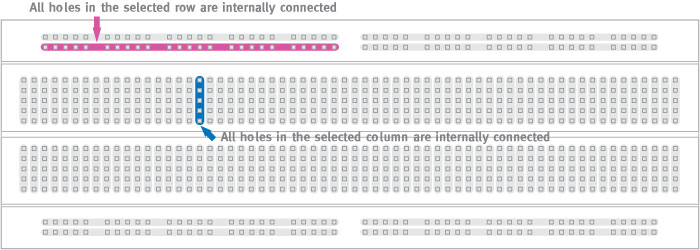
As illustrated in the ENGR 44 Lab book, connect the leads of the DMM to two holes with:
  1. the same column on one side of the channel.
  2. the same column on opposite sides of the channel.
  3. different columns on opposite sides of the channel.
  4. same as #3, but with a jumper wire connecting the two columns.

ANALYSIS:
Case 1:
R = 0.5 ohms

Case 2:
R = infinity ohms

Case 3:
R = infinity ohms

Case #4:
R = 0.6 ohms


CONCLUSION:
In case 1, we measured a resistance of 0.5 ohms between two holes on the same side of the channel, we can conclude that it is a closed circuit. For case 2, we measured infinity ohms between two holes on the same column on opposite sides of the channel, there is no continuity between them. Thus, we can infer that it is an open circuit. Similarly, in the third case, we measured infinity ohms between two holes on different columns on opposite sides of the channel. This indicates that we have an open circuit with this setup. However, if we modify this set up such that there is a jumper cable connecting the two columns, then we measure a resistance of 0.6 ohms. This demonstrates that we have created a closed circuit between these two holes. Using this information, we can infer that electrical connections across the channel are open unless they are connected using a jumper wire. Furthermore, we can conclude that holes connected by the same column on one side of the channel are closed circuits. I think the following image provides a concise representation of the internal connections of this breadboard:


For more info, click here.